Exploring Balinese Art & Color

by HRM on November 7, 2011

A Rough Guide by Savannah Hughes

Traditional Balinese art depicted in a painting

Life in Bali is based on art. It’s so essential, that there is no word for “art” in Balinese. It is difficult to explain the relationship that the Balinese have with art to someone who has never seen it. The Balinese carve, weave and paint beautiful objects for daily use – they become objets d’art in the most pristine sense of the word. The Balinese have a kinetic, green, tangible relationship to art.

Westernized Balinese artNowadays, the Balinese art scene has become more westernized. In tourist hot spots like Ubud and Kuta, art communities have been contorting their styles to meet Western demand and get the bule’s* dollar. Westernization is a controversial subject in Balinese art circles. Less famous artists are resentful that they have to toe the line between their maintaining traditional artistic ideals and adapting to this new Western trend. However, in more rural parts of Bali, the traditional Wayang style can still be seen, going strong.

Art isn’t only an economic need for Bali: painting and woodcrafts have been a central mode of communicating myths. Intricately detailed paintings explore central religious themes like the conflict between good and evil. Another popular theme within the same vein is the Balinese-Hindu epic of Rama and Sita. This Javanese version of the story is disseminated through dance and painting. It can provide a form of spiritual and aesthetic guidance too.

Bruce Sherratt against one of his paintingsLike Paris, Bali’s artistic draw has pulled in many expatriates. Veteran artist Bruce Sherratt currently lives in Ubud, Bali, Indonesia. He says, “Art is not a hobby or pastime here. The culture and the economy depend on all kinds of arts and crafts.”

Now with over 40 years of educating experience in international schools, Sherratt founded the Bali Center for Artistic Creativity (BCAC) where he holds workshops and lessons for painting. He holds a strong background in surrealist painting and uses a psychotherapeutic approach to teaching. He offers lessons which incorporate Balinese culture and context and beginning painting skills. Ubud templeAs an educator, he welcomes all to his studio. “My art is always available to anyone who swings by my art center and studio or who knows me.”

Bruce also believes that in order to teach a subject, you must work at it daily. He takes a hands-on approach to painting and art in general. This isn’t as difficult as it sounds, living in Bali: the rich environment provides a wealth of inspiration. Lush tropics and a creative community could be a muse for even a novice painter. However, Sherrat believes that “Inspiration comes from my own inner need to paint and reveal the aspects of life and the world that might not otherwise be visible.”

*Indonesian slang word for White Foreigner.

Traditional Wayang art

{ 0 comments }

Exhibition at Le Musée des Arts Décoratifs, Paris

It was eighteen years ago that Hussein Chalayan’s graduate collection made him an overnight sensation. Since then the Cypriot born, London based designer has pushed the frontiers of fashion, architecture and design as is evidenced by the impressive overview of the designer currently showing at Le Musée des Arts Décoratifs in Paris. The exhibition claims to be split into two though thematically there is some overlap. The first level explores the political, cultural, religious, and geographical ideas on which his approach is founded. I am sad Leyla (2010), consisting of a film projection and multimedia installation uses Turkish music which has evolved through political reforms and cultural relations whilst Afterwords (A/W 2000) refers to the ethnic cleansing of Cypriot-Turks in Cyprus. The second is more concerned with movement and displacement. Migration, speed and the interpretation of space and time are the focal points here. The result of this rough divide is the creation (perhaps unwitting) of a contrast between projects implying liberation and those which have a restrictive, almost oppressive feel.

Hussein Chalayan

It is in his exploration of the political that Chalayan’s work feels most restrictive. The collection Between (S/S 1998) showcases dresses pinning the models’ arms to their sides. Delicate gold beading on one piece serves simply to tie one’s hands behind one’s back. Chalayan covers faces with Burqa-style dresses removing any sense of identity or individuality. The obliteration of identity is a common theme in these more political works, perhaps a reflection of Chalayan’s own somewhat ambiguous cultural identity. Elsewhere, de-personlisation and oppression appear to play out alongside each other. In Panoramic (A/W 1998) the mannequins’ faces are camouflaged by structured headpieces, their backs turned to us as they paint the walls. Blindscape (S/S 2005) depicts models as gardeners, their faces turned to the ground, whilst in Manifest Destiny (S/S 2003), the figures clean the glass of their exhibit case with socks.

Hussein Chalayan

In stark contrast to this, the second level of the exhibition pursues themes of travel, flight and movement. The effect is a sense of liberation; of freedom. Floaty silk dresses are blown from beneath in Airborne (A/W 2007) indicating transience and flux which the seasonal theme of this collection embodies. Figures covered head to toe in black bring a dress to life in Sakoku (S/S 2011) Movement is not always expressed in terms of the transience of nature: Robes , taken from the first commercial collection, Cartesia (A/W 1994) offers dresses which can be folded into airmail envelopes; the infamous mechanical dresses morph from the historic to the modern (One Hundred and Eleven S/S 2007). The theme of flight continues with the arts project Repose (A/W 2006) showing a disembodied flight with passengers sitting outside the plane. This unconventional scene is, according to Chalayan, ‘a reaction to the absurdity, the excitement and the violence of flying manifesting itself as an out of body experience’.

Hussein Chalayan

Most interesting, however, are the pieces where the concepts of movement and restriction co-exist. In Afterwards (A/W 2000), Chalayan explores the refugee, specifically the need of those confronted by war to dissimulate and transport their belongings on their exodus. Chair covers become dresses; chairs become suitcases; finally a table transforms to a voluminous skirt. As the models leave the stage the room is left white and bare. All previous signs of life have been extinguished. The theme here is movement and travel albeit with a political edge. The movement of refugees is not liberating; it is borne out of the necessity. It is the result of oppression. Aeroplane Dress (1998), a short film directed by Chalayan also embodies this duality. The dress worn by the model in the film is formed like a section of a plane, a symbol of speed and movement. Yet the model herself remains static, rotating of the spot throughout the film. The restrictive elements of migration and exile are simultaneously expressed in the physical restrictiveness of the garments. The model hobbles gingerly in her table skirt in Afterwards. The Aeroplane Dress made of resin allows for very little physical movement. It is in works such as these that the complexity of Chalayan’s work really finds its form.

Hussein Chalayan

This is only a glimpse of the intellectual ground which Chalayan covers in his work. The designer’s work from his graduate collection to the most recent Kaikoku (A/W 2011) is brilliantly showcased in this exhibition. It’s on till the 13th November. Go see for yourself.

{ 0 comments }

Etudes (trois repas americains)

by HRM on November 2, 2011

Photography by Cara Tobe

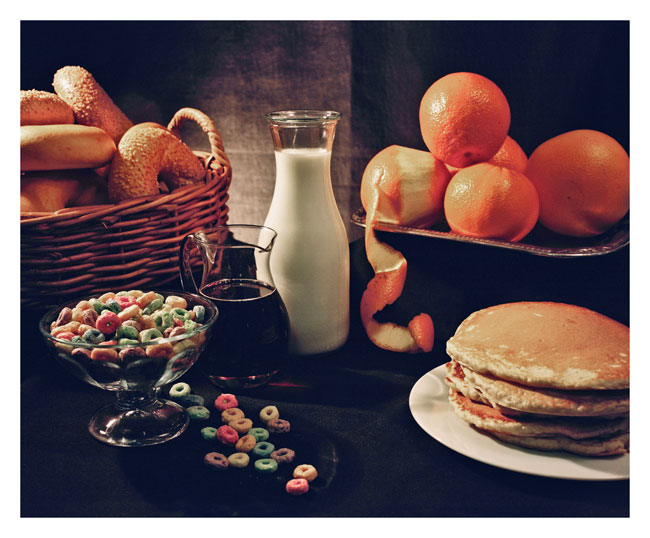
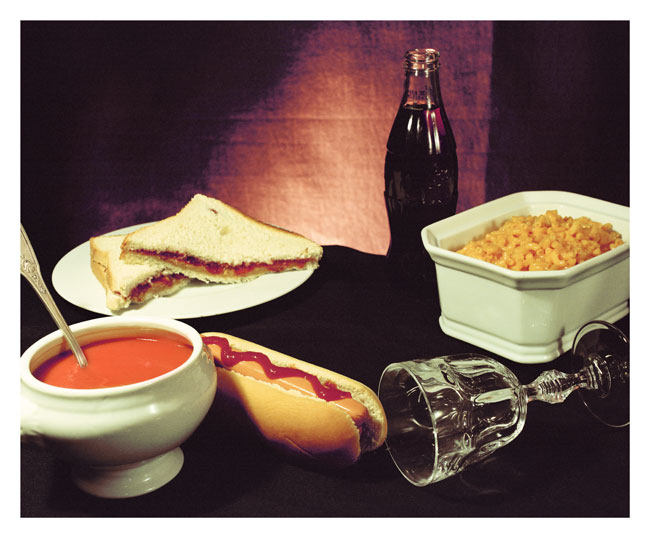
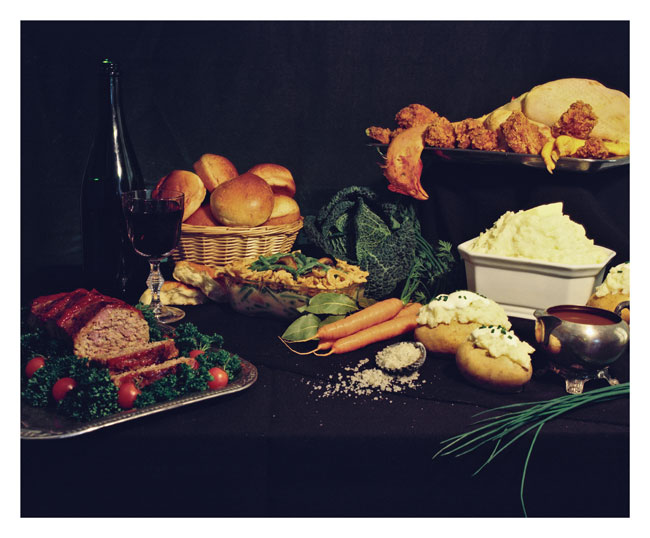
These three studies form part of an ongoing project in still life photography. In “Trois repas américains”, the work of painters Willem Claeszoon Heda and Jean-Baptiste-Siméon Chardin is drawn upon to restage the principle meals of an American day – their assumed and stereotypical constituents – in a consciously de-familiarized setting.


All photos for sale for €120 euros, without frame. Signed and numbered editions out of seven. Printed on Hahnemuhle Fine Art Rag paper.

Breakfast

Etude – Breakfast – USA (30 cm x 25 cm). Cara Tobe. 2011. Signed, numbered edition 1 of 7.

Lunch

Etude – Lunch – USA (30 cm x 25 cm). Cara Tobe. 2011. Signed, numbered edition 1 of 7.

Dinner

Etude – Dinner – USA (30 cm x 25 cm). Cara Tobe. 2011. Signed, numbered edition 1 of 7.

Cara Tobe is an American photographer working out of Paris, France. After growing up in Wisconsin, USA, she traveled to the Swiss Alps were she discovered her love of photography. Cara graduated in 2010 from SPEOS Photographic Institute in Paris, France where she is currently working as a freelance photographer and artist.

She recently exhibited the first part of an ongoing photo project called “Nature Morte” at Kooka Boora Cafe in Paris. Cara Tobe is the co-founder of the Haecceity Project, an artist collective developing the conjunction between the visual arts and literature.

More prints available upon request – please contact the artist at caratobe@gmail.com. Website: www.caratobephoto.com

{ 0 comments }

James Franco and Allison Higgins

by HRM on November 1, 2011

Videos from a collaborative performance

Allison Higgins began to make work using James Franco’s image as a way to explore the question of celebrity, sincerity and identity. Ultimately, Franco’s image wasn’t enough: she needed to work with his work. These videos document the performances that the two artists enacted simultaneously. The process and product of their collaboration is published in the 11th issue of Her Royal Majesty: buy the printed version here, and the full pdf here.

{ 0 comments }

Launch of Issue 11

by HRM on October 26, 2011

1/11/2011

For all of you that are Paris-based, mark your calendars: the launch party for the 11th issue is next Tuesday. For those of you unable to make the event, you can pre-order your copy of the magazine here.

11 HRM poster

The latest edition, 85 pages and perfect bound with a glossy cover and watermarked pages, is a thing of beauty. The cover art was created specially for this edition by Badaude, and the printed version comes with a mini-magazine insert that folds out into a beautiful poster by Dan Estabrook on one side, and self-portraits drawn by all of the contributors on the other.

11 cover

Focused on the theme of Doubles, the works collected in the 11th issue explore questions of duality, opposites and partnership. A new collaboration between James Franco and Alison Higgins illustrates how two people can lead similar lives and have similar goals but with very different outcomes; a story of a parasitic twin reveals quelched potential; illustrations of Finnegans Wake by Stephen Crowe call into question the nature of duplicity and partnership; a new story by Lauren Elkin about partners that become enemies and have a duel in Les Halles…

The magazine will be available for sale at a discounted price at the party, and original artwork by Matthew Rose, Fiona Kinsella and Cara Tobe will be exhibited, along with special edition artists’ prints of work featured in Her Royal Majesty by Mia Funk, Rosy Lamb, Grant Creegan and Lendl Barcelos.

There will be three performances, all female duets, beginning at 9:30pm:

THE MOB presents a mix of slow-soul-heavy-heart music and contemporary dance. The Mob is two girls from Sweden who, under this alias, tell stories of another world – this world – with their bodies and their voices. Both performers were educated at the Danish National School of Contemporary Dance. Their work includes site-specific work together with architects and designers, dance-performances and musicians.

the mobLINDA HALL is Sonia Pavlik, a performer embodying and paying homage to Linda McCartney and Annie Hall. Accompanied by Valentin Ottone, the two women make music influenced by Anglo pop-rock and American cinema.

EMMA-KLARA sings gospel and folk on the Paris metro where she was stopped by a producer who wanted to include her in a documentary of Parisian buskers. This Swedish vocalist will be accompanied by French pianist.

See you on November the 1st!


{ 0 comments }

ISSN: 2116 34X