Before months existed

by HRM on June 7, 2011

The Literary Conference: Agadir, Morocco - Day 1

Morocco

Until now I have concealed my purpose under the accommodating guise of literature. Because I am a writer, this causes no particular concern.
– The Literary Conference, César Aira

Flying over the Atlas Mountains, three thousand feet above Agadir, a man leans over and shows me his empty customs form.

“We must fill it in?” he asks, in choppy French.

“Yes,” I reply, punctiliously.

Atlas Mountains“Please,” he says, and puts his paper on my fold-out tray. I look at it, and look back at him blankly. He makes a sudden expression of surprise and finds, within his old leather satchel, another (older, crumpled) practice form with all the necessary information filled in. He gives me this other paper and makes a “satisfied” face.

Name: Mohamed M.

“What’s your last name?” I ask.

“No matter,” he says, pointing with blunt fingers to the form.

I continue, somewhat sceptically. Birthday: 1931.“When were you born?”

He points to the page. “1931,” he says.

“Yes, but what month?”

“I don’t know, no matter. There is no month, this was before months.”

“You don’t have a birthday?”

“Oh no, no, no!” and he laughs at me. I am starting to feel like literacy means little when the rest of the rules are so different.

Job: Salary.

“So, what do you do for your job?” I ask.

“Salary, I salary.”“Yes but what do you do for your salary?”

“I do nothing!”

“You do nothing?”

“I do nothing. I do not work. I ra-té-té,” he says.

I make a “do not understand” face. He repeats, and repeats again.

“I do not work, I ra-té-té!”

“You are retired? Retraité?”

“Yes! Yes!” he is delighted, his silly student finally understanding, the communication barrier breached enough to cover the basics, but no more.

For my part, I never know what to say in the box where you are supposed to write your profession. In this case, as I was sent to cover the conference, I ticked the “work” box and write “writer.”

The customs official seems to take issue with this.

“You write for what?”

“A magazine.”

“So you are journalist.” It is not a question. I do have a press pass, somewhere, which may or may not be expired.

“Okay.”

“What is the name of the magazine?”I tell him.

“Write it down.”

I do.

“Her Royal Majesty?”

“Yes, it’s a literary magazine.”

“Oh, literary, okay, great. Is there a website?”

I never thought I would be cultivating a fan-base among the customs officers at the airport, though I could not tell if he was sceptical or impressed – is she a royalist or a writer?

{ 0 comments }

On never being absent

by HRM on May 8, 2011

An interview with Ibrahim Abdel-Meguid
Marrakesh

Photograph by Harriet Alida Lye


At the Literary Conference in Agadir, I discussed mathematics and the revolution with renowned Egyptian novelist Ibrahim Abdel-Meguid. Instead of saying at that time, or long ago, Abdel-Meguid says “once a day.” As we were walking along La Corniche with the group, he said to me “once a day, I fell in love.”

Interview by Harriet Alida Lye

HRM: Did you always want to be a writer?

Ibrahim Abdel-Meguid: I wrote my first short story at 15 and ever since then, yes, I knew I wanted to be a writer. Before that though, and even at times since, I’ve wanted to be a mathematician.

HRM: Being a writer with a background in mathematics probably leads to excellent craftsmanship and a strong sense of balance. Does math play any role in your writing?

IAM: Yes, definitely. When I was young I read some books about the history and philosophy of science, and that took me to philosophy itself, which is inextricable from mathematics. Also, I feel that writing is something that has to be built according to specific measures: the story is a building that can not be distorted and I try to stick to these measures as much as I can.

Ibrahim Abdel Meguid

Ibrahim Abdel Meguid, photo by Harriet Alida Lye

HRM: How do you think the revolution in Egypt will affect contemporary literature?

IAM: Our revolution means a great turning point in the history of the nation, so it will come with new writers and artists as well as new visions of the world and from previously unconsidered perspectives. How that will be? It will take some time to fully answer that question, but now, for example we see more books in Egypt about the revolution itself, socially, politically, and so on. Everyone has something to say, people talk about politics on the street; people are invested now, and everyone has an opinion. There will be new novels, new poetry, new content and forms, but this will take time.

HRM: What are you currently working on?

IAM: I just published a short story in an Egyptian magazine about love. I have been writing for such a long time, usually I am no longer nervous or precious about my work, but with this piece I feel like a nervous young boy! The story is called “Why didn’t you come yesterday” and it’s about a mismatched couple who meet in a garden. They fall in love immediately but remain strangers to one another. He is a middle-aged man, she is a young girl. She is suffering loneliness. She usually likes to go outside of the city, to a beach in winter. Before, when she was younger, she had met a man on the beach. She was sad, and he kissed her, and then he disappeared. There was nobody there, only clouds and waves, which don’t count. She could not catch his features. He was like something magic. When she got older, she forgot the whole story. Then, in this garden, she meets this middle-aged man, and both of them are also alone. She does not to reply to him when he calls out to her, but they still see each other regularly, their routines overlap.

Ibrahim Abdel Meguid

Ibrahim Abdel Meguid, photo by Harriet Alida Lye

One day, he gives her a command: Come to the garden on Friday. She does not come to the garden on Friday. On Saturday, she comes, and she finds an old man, very old, much older than the other man, and he asks her: Why did you not come yesterday, why were you absent. This time, his daughter is with him and she tells her father that he is acting very strangely. One time, a long time a go, the man says how he went to the beach in winter. He was ill, he was sad. When he returned from the beach, he was a young man and when he came to the garden he was happy and stronger, but then, all of a sudden, his age catches up with him. As he is telling this story, the girl remembers the man on the beach for the first time in years, and she takes the man before her to her chest, deciding never to be absent again.

People are asking me to write about the revolution but I wanted to write about this. The story of the revolution is still happening and will take some more time to get right. Now, I am preparing a book about the days in Tahrir square. I was there with the people for fourteen days, day and night, and I saw how Egypt returned to its real history. What glorious days! The book will be published soon.

Ibrahim Abdel Meguid was born in Alexandria in 1946. He is one of Egypt’s most respected and well-known authors. He published his first novel soon after completing a BA in philosophy at Alexandria. All of his novels and short stories are set in Egypt during particular historical periods and many translated into French and English. Among his best known are No One Sleeps in Alexandria, The Other Place and Birds of Amber. In 2009, he was awarded the Taqdireya prize, one of the most prestigious prizes in Egypt, recognizing the collection of his work.

{ 0 comments }

Dark and Grimy

by HRM on May 8, 2011

Interview with New York illustrator Chelsey Pettyjohn

I first met Chelsey when we were waitressing together in the Lower East Side. With her signature bright lipstick and wild sense of humor, she stood out in the fancy restaurant where we worked. One of the first pieces she showed me was an early drawing she made while still a photo major. In the piece, a man is lying with his head thrown back while a black, hairy rat crouches on his shoulder. The vulnerability of the man’s exposed neck and the sinister possibilities of what the rat might do combine revulsion and hilarity, a theme that is prevalent in her work. We sat down for the interview over Skype, and she waved her computer around to find the best internet connection in her Brooklyn apartment, finally placing it on a little ledge in her wall.

Chelsey Pettyjohn

Elise, Chelsey Pettyjohn

Interview by Rachel TonThat

HRM: What got you interested in illustration?

CP: Well, I started off as a photo major and did that for a year. It was great, but I wanted to do more. I felt sort of restricted with the medium, and I couldn’t see myself sitting in a Studio & Light class for another year.

At that time, I discovered this artist named Justin Lee Williams and was really into his work. I had never thought about illustration, period, up until that point, but his work inspired me to try drawing. I knew I was bad, but I also knew I was so bad I was kind of good. And the rest, as they say, is history.

HRM: Has photography influenced your illustrations?

CP: Definitely. I see things with a photographic eye, and I draw from my own photos a lot. I’m experimenting lately with collages, drawing portraits on top of photo backgrounds. I like the result, but I’m still experimenting to see what works.

Chelsey Pettyjohn

Bridge Collage, Chelsey Pettyjohn

HRM: What are some of your other artistic influences?

CP: Lina Scheynius, the photographer, influences me in a huge way. I draw from her photos constantly, and I think she’s amazing. I look at a lot more photographers than I do illustrators. And I’m also influenced by film – kind of darker stuff like Harmony Korine’s work and “This Is England”. I just love dirty, grimy stuff. It’s more fun to draw.

Chelsey Pettyjohn

Nicolas, Chelsey Pettyjohn

HRM: Have your visits to Paris had any influence on your work? And what do you think of the New York-Paris connection prevalent in film, art, and literature?

CP: Certainly. I first got into photography when I was seventeen and in Paris for the first time. A girl let me borrow her film camera when we went to Versailles and I fell in love with it. So, one thing led to the other in the years following. I was in Paris earlier this year and shot a lot of backgrounds that I’m planning to use in some collage-type stuff soon.

In terms of that connection, New York and Paris are my two favorite cities on earth. I think they definitely bounce artistic ideas and influences off of each other. How many New York filmmakers were influenced by Jean-Luc Godard? Well… I don’t know. But probably a million. He’s amazing! It’s all a constant circle of influence, past and present.

Chelsey Pettyjohn

Leaves, Chelsey Pettyjohn

Chelsey Pettyjohn is an illustrator, photographer, and writer living and working in New York City. She is currently studying Illustration and Writing at the New School. Her work can be seen at www.hideousthings.com

{ 0 comments }

7 Questions for 5.6

by HRM on April 27, 2011

An interview with Parisian photography collective

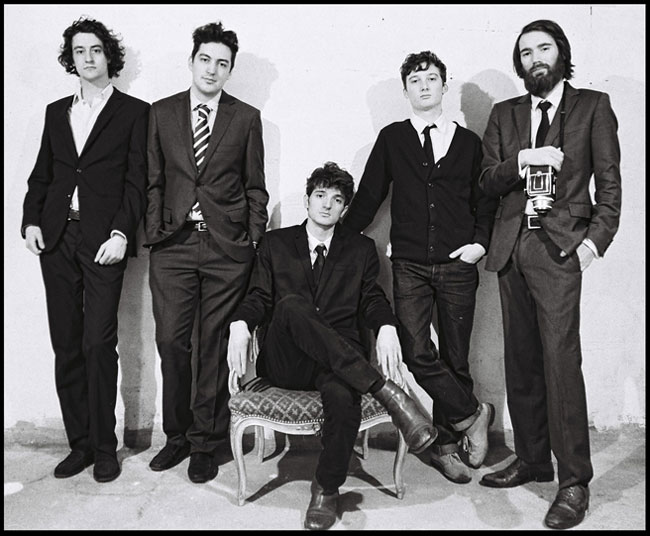
The latest exhibition of Collectif 5.6 was somewhat haphazard. There were no signs posted and only a crowd of young Parisians gathered around the building indicated that something was happening. Inside a variety of pictures had been hung up with no indication of which member of the collective they belonged to. Intrigued, I contacted them for an interview and three days later I sat down with Laurent Nalin of Collectif 5.6 in a quiet courtyard in Saint-Germain-des-Prés to discuss the exhibition.

Collectif Cinq-Six Portrait

Untitled, Louis-Marie du Perray

Interview by Rachel TonThat

HRM: How did the five of you meet and why did you form the Collectif?

Laurent: I first met Louis Marie at primary school, about ten years ago, and the others met at a different art school in Sevres. Together, we started the Collectif almost two years ago when we realized we were all involved in analog photography. We were spending a lot of time together and were already exchanging ideas and points of view, so we thought it would be easier to share a lab and to exhibit our work together in order to have more of an impact, to create a synergy.

It’s important to remember that we’re an independent collective: we don’t want to sell anything or to prove anything or to explain anything. We just want to create something. We’re very lucky in a way to allow ourselves to do exactly what we want, not having any pressure, any deadlines. That’s important.

Collectif Cinq-Six

Untitled, Martin Plagnol

HRM: Is the Collectif interested in digital photography?

Laurent: Not really. We’ve never worked with digital because it’s better for us to have direct contact with the picture and to work directly with the light. I consider digital photography to be a flat image, something that has no staying power because it contains no depth, whereas analog photography has a tactile quality. Light hits the film and you can see the physicality of the exposure. When you look at a digital image you don’t know what to look at because every part of the image has the same amount of information.

HRM: If you take a picture meticulously, using the light, do you think that the image exposed onto the film is the photograph, or do you believe that it needs to be printed in order to become a work of art?

Laurent: Of course, the most important part is taking the picture but printing is an essential part of the process because it allows the photographer to refine his image, to create certain tones and to strengthen or soften contrast. A picture isn’t finished until it is printed.

Collectif Cinq Six

Untitled, Adrien Casalis

Collectif Cinq-Six

Louis-Marie du Perray

HRM: What are your interests outside of photography?

Laurent: Laurent: I study French literature and poetry at the Sorbonne. Adrien works in cinema- he wants to direct movies. Louis-Marie is a graphic designer, Martin is a full-time artist studying at Les Arts Décoratifs in Paris, and Vincent studies Business and Ecology in Sweden.

HRM: Despite these different backgrounds, do you all share the same aesthetic sensibilities?

Laurent: More or less. Our styles are very different but we agree on the essentials of photography. It’s hard to describe, but sometimes we understand each other without talking about it. We see a picture and without discussing it, we share the same feelings about the picture.

Collectif Cinq-Six

Untitled, Vincent Fremont

HRM: As a collective are you interested in photographing the same subject matter?

Laurent: We are going through different stages. At first we were very close, but we are all trying to explore new things and everyone is going their own way. But this is a good thing. For a long time I was fascinated by the human body and shot nudes, but even that’s changing. I don’t know what’s next. It could be anything.

Collectif Cinq-Six

Untitled, Laurent Nalin

HRM: How did you set up the exhibition on the 19th?

Laurent: That was unusual. An art association that wants to develop artists and give them a space squatted the building. At some point they owned the building and ran a gallery but it now belongs to the city of Paris. So we had this large gallery space on the first floor. It was only up for two nights, though- the cops came on Saturday. But it’s all part of the game; you never know what will happen if you exhibit in that kind of space. It was empty for four years and it’s going to stay empty from now on.

Collectif Cinq-Six

Untitled, Martin Plagnol

Collectif Cinq-Six is comprised of Laurent Nalin, Adrien Casalis, Louis-Marie du Perray, Vincent Fremont, and Martin Plagnol. They share a laboratory in Versailles and named themselves after the F-stop 5.6. More of their work can be seen at http://collectif5-6.tumblr.com

{ 0 comments }

ISSN: 2116 34X