Where the Concrete Desert Blooms

by HRM on January 30, 2012

interview with Tings Chak, by Harriet Alida Lye

Tings Chak

For four years, Hamilton was my playground. This is a story of its stories… Mostly, this is a story of how I came to fall in love with a place, with its imagination and creativity, and how I began to see that the spirit of activism lives in stories, our collective visions of what we can build, the grass through concrete.”
– Tings Chak

Born in Hong Kong and raised in Thornhill, Tings Chak chose Hamilton, Ontario, for a home for her university years. Her graphic novella, Where the Concrete Desert Blooms, tells the stories of Hamilton – the hammer, steel city, lunch bucket town – through its history, intimate interviews with its residents. Linking all this is the desire to find a home. As she says, it is “a story of being present, or seeing the place you live as a place in and of itself, a story of where we go from here.”

In a way, then, Hamilton is irrelevant. The book is about place-making and relationships, activism and a belief in social change. “All I knew,” Tings says, “was that I wanted to have a reason to meet with people, listen to stories, and wander around unfamiliar places, all in the discovery of what makes a space a place.”

After she graduated, Tings moved to Paris, but part of her was still in Hamilton: it was here in Paris that she compiled her notes and worked on Where the Concrete Desert Blooms. Tings and I sat down for a dinner of soup and winter squash at her home, a vegan co-operative in Toronto, to talk about placemaking, art, architecture and inspiration.

Tings Chak

1. You’ve been painting and drawing and writing, independently of one another, for a long time, right? What drew you to making comics? How is it different to work in this medium?
It’s a bit of cheating, really. I draw the things I can’t describe in words, and write the things that are too difficult to draw. I think that drawing and painting are often about fixing a moment in the world onto a two-dimensional space, whereas sequential art is in motion. I find this to be an exciting challenge, to convey the passage of time, the atmosphere of a setting, and the hierarchy of moments with words and images.

Tings Chak2. Your book is very rooted, in its discovery and documentary nature, in the city of Hamilton. Could you have made this book about a different place? Why Hamilton?
One of the things that I learned in the process of making the book, and this is the main theme, is the importance and possibility (and even neccesity) of understanding the place that you live in as a place in and of itself. Hamilton, living in the shadow of Toronto and its more glorious industrial history, is always a place relative to elsewhere and to another time. I wanted to change that feeling in me, to create a space, a home in the present, from which I could begin to engage with Hamilton. This process of placemaking is not unique to Hamilton. I believe that it can happen anywhere. I think I am finding it a bit harder to do this in Toronto, though, which is where I live now.

3. Why would placemaking in Toronto be more difficult?
When I was living in Paris, I found it amusing that I would spend my time drawing and writing about Hamilton of all places. As it turned out, Paris was a perfect place for this. I cannot think of another place, real or imagined, that has had more words, paintings, music, and art of all forms dedicated to it. Paris exists in most everyone’s minds (and hearts); it certainly doesn’t need me to make art about it. Likewise, Toronto is validated as a place of its own, whether loved or hated, by most Canadians. For me, there was Hamilton, unknown and without a reference point to me, with its arms wide open, proclaiming, you are here. Nevertheless, I still believe that in both Paris and Toronto, one can find one’s place in in-between spaces, however small or difficult to create.

4. What came first for you in this project – the text or the images? What was the original idea or impetus that started you?
The text came first. After transcribing the dozens of personal interviews that I conducted with artists, activists, educators, and steel mill workers, I tried to string together the bits of stories that really stuck with me into the loose themes of placemaking, activism, and oral tradition. What came out was a version of narrative journalism comprised of retold stories and personal reflections.

The commitment to writing a graphic novel came as a surprise to me. While helping a friend at the maker’s market in Hamilton, a painter I had just met asked me, “Do you make things too?” I confidently replied, “Yes, I am writing a graphic novel.” I had told a lie, but I liked the way it sounded, so I spent the next two and half years making that lie true.

Tings Chak

5. You are currently completing your Masters in Architecture. Do you see a connection between comics and architecture?
For me, the relationship between comics and architecture is about narratives in spatial production – which stories are told, and retold, and which stories are silenced through the places that we construct. It is also about representation. Beneath the dominant story of a place, be it written in history or built with stone, there are diverse and often contesting narratives. I believe that it is important to give voice to these stories, what Michel de Certeau calls “pedestrian speech” – the everyday footsteps that architects, planners, and urbanists in their “aloof space” should be better attuned to. How is our built environment experienced, imagined, and used in the everyday life, and most importantly, how do and can we come to know this? So yes, I see a connection and I try to reinforce this in my work.

6. What, or who, are you inspired by right now?
I am really inspired by the activist communities around me. As an immigrant/settler in Canada, a country built on the continued occupation of indigenous lands and the oppression of indigenous peoples, I am constantly thinking about the occupation of space. Maybe my being an immigrant here, searching for my own place, heightens this. The Occupy movement brought some of this criticism to the forefront for the mainstream, questioning what forms occupation takes, what has been occupied and continue to be occupied, who are the occupiers and occupied, and why? To me, the idea of contesting space and dominant narratives is a real struggle for space, a struggle about cultural and ecological survival, and a struggle that is a constant source of inspiration.

Tings Chak

6. There seems to be an “I” in graphic novels that is different to the “I” in traditional memoirs. Most of my favourite graphic novels are autobiographical (Blankets, Fun Home, Maus, Persepolis…), and so is yours. (I don’t know how to phrase this question but I want to say something like “What about comics enables this fluidity”?)
I agree, but this is too hard to think about or answer!

8. Could you be the artist or illustrator for someone else’s story, or do you think that the text and image have to both come from you?
Unless I was involved in the development of the story itself, I don’t know if I could ever visually represent someone else’s intention and vision. We live in a visual culture that is saturated with images, and so we are quick to respond emotionally to what we see (before responding to what we read). There are many choices one makes in terms of stylization, linework, framing, colours, and textures in illustration – that is just too much responsibility for me!

9. What is your next project?
I have always wanted to illustrate the stories of my childhood roadtrips throughout Eastern Canada and the United States. My mother always insisted on bringing my non-English-speaking grandparents along, so the five of us piled into our little white Corolla and drove to every small town we could find, from the towns outside of Toronto to Cape Spear. Over the much-cherished winter holidays, we’d end up in places like Sault Sainte Marie (pronounced SOO saint marie), a steel-making shipping town at the mouth of lake Superior, home to the largest shopping mall in northern Ontario.
On these trips, while we were always an interesting spectacle for the locals, we would often find that one Chinese restaurant run by that one Chinese family in town. I now appreciate these quirky experiences, and over the years I have developed a more serious interest in diaspora, particularly in the relationship between the forces of migration and cultural transmission.

Tings Chak

{ 0 comments }

Marianne Chargois

by HRM on January 19, 2012

Photos by Kit Brown

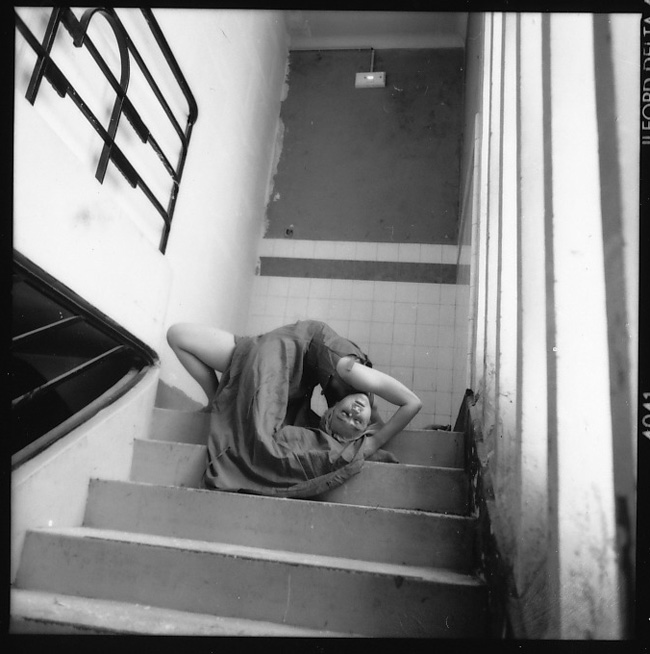
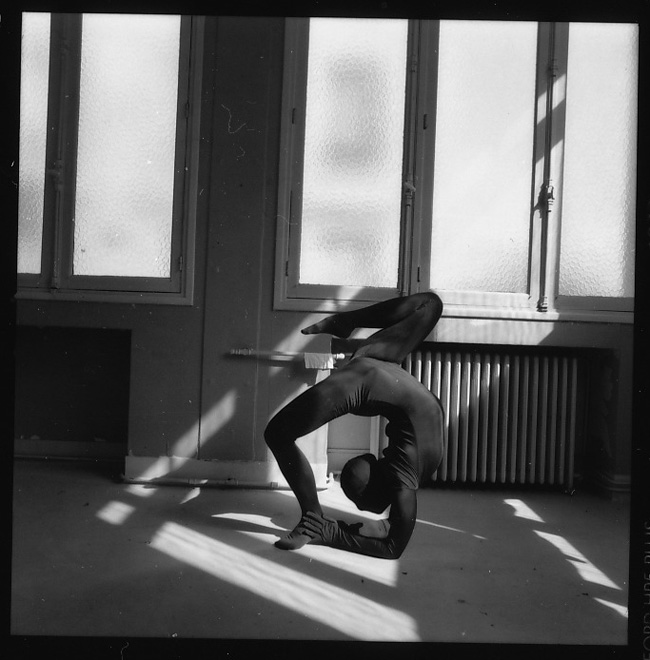
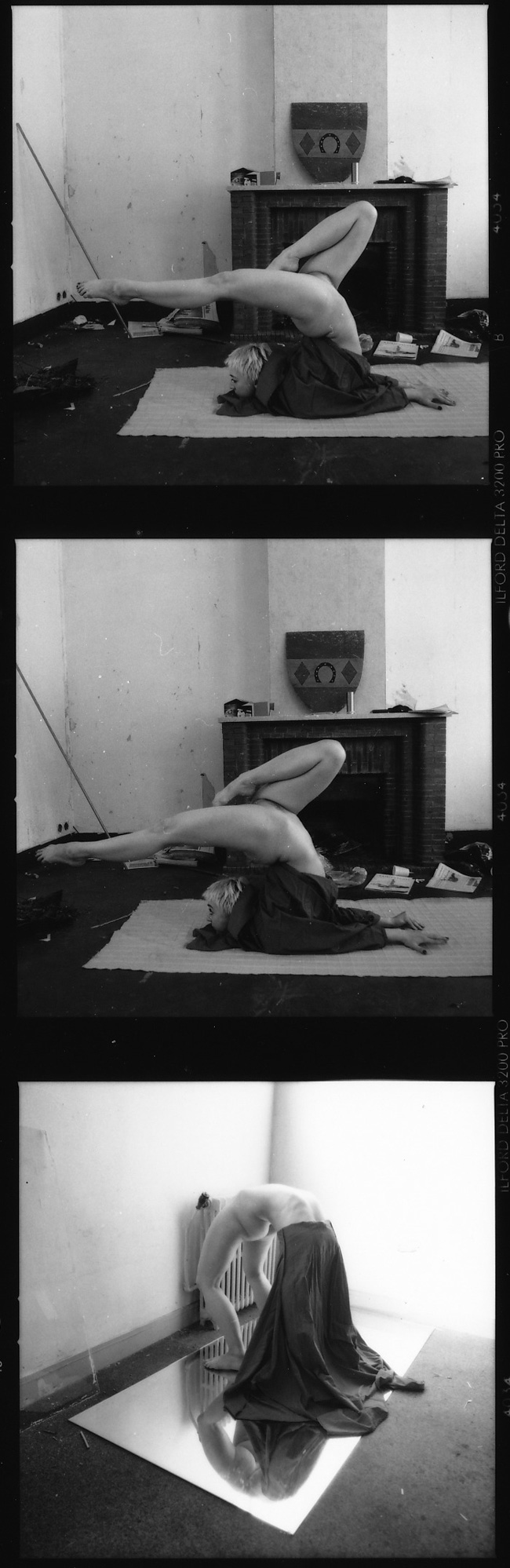
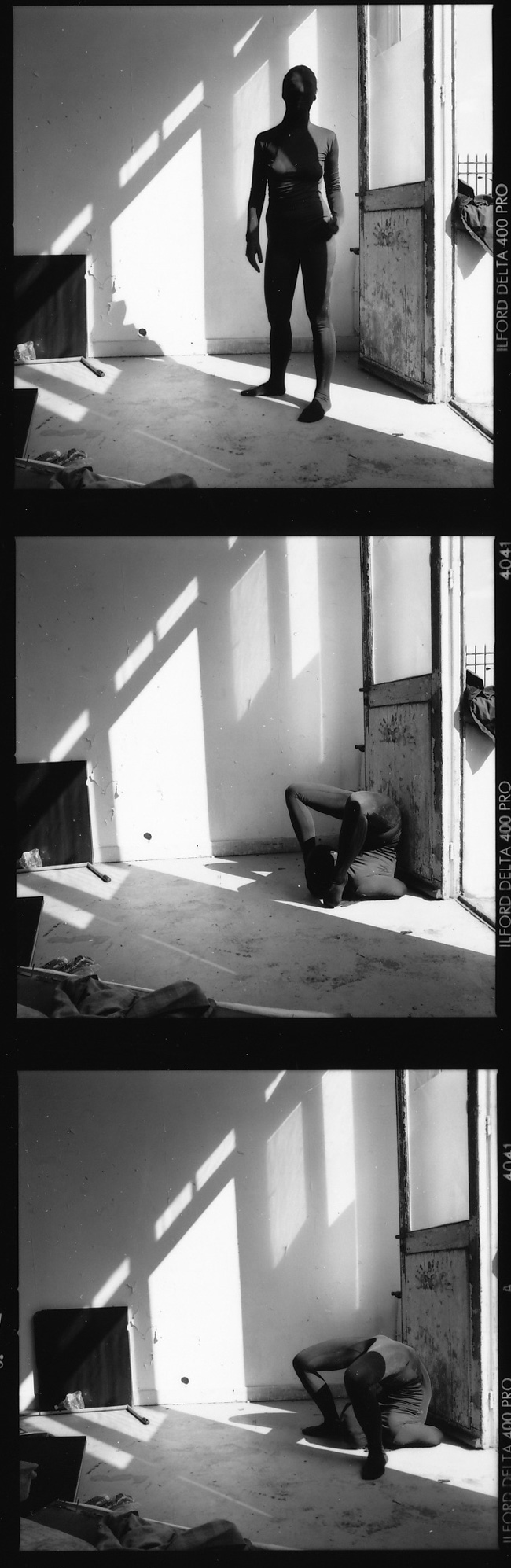
Marianne Chargois, contorsionist, actress and sex worker, performs her daily life and nourishes her stage work with her experiences. She works essentially with strangers that remain strange, and occasionally with familiar faces that remain so.

All photos by Kit Brown.

Marianne Chargois

Marianne Chargois

Comment veux-tu que je t’appelle quand l’intèrieur de ta bouche cesse de ressembler
à une parole, quand tes seins sont à genoux derrière tes doigts et quand tes pieds s’ouvrent ou cachent l’aisselle, ta belle figure en feu…
Les épaules ont le contour de tes hanches: sur le dos du costume figure, renversé, ton devant nu, de façon que monte naturellement entre tes fesses la verticale, qui dans l’image sépare les seins.”
(Hans Bellmer; Petite Anatomie de l’image)

Marianne Chargois

Marianne Chargois

Marianne Chargois, contorsionniste, comédienne et travailleuse du sexe, performe son quotidien et nourrit sa pratique de scène de ses expèriences de vie. Elle travaille essentiellement avec des personnes inconnues qui le resteront, et épisodiquement avec des personnes reconnues qui le resteront. Photos par Kit Brown.

{ 0 comments }

EVERYBODY SLEEPS

by HRM on January 16, 2012

Interview with Blake Butler, by Andrew James Weatherhead

I discovered Blake Butler’s writing by accident. I was walking down a street in the Park Slope neighborhood of Brooklyn, which is where I think Moby lives, when I happened upon a box of books on someone’s stoop. Putting unwanted books out for people to take is common practice in Brooklyn, but what’s uncommon is finding anything worthwhile among the freebies. quotesYou can probably see where this is going. One of the books was a lot bigger than the others. It was a galley proof of a novel called There is No Year and it was by a person named Blake Butler, a name I’d seen on the internet but knew nothing about.

I took the book home and read it shortly thereafter and found it to be 400 pages of the best possible sentences.

Rare is the excitement of discovering an author as original as Blake Butler. In reviewing my favourite sentences I felt the particular nostalgia of not just wanting to experience the book again but wanting to experience the book for the first time again. Thus, I have eagerly sought out and devoured each of Blake’s other books – a novella, Ever (Calamari 2009); a novel-in-stories, Scorch Atlas (Featherproof 2009); and his newest, the memoir Nothing: A Portrait of Insomnia (Harper Perennial 2011), which, as the title suggests, concerns the author’s insomnia, though is much more than your standard memoir.

Blake was kind of enough to field my questions about Nothing: A Portrait of Insomnia, his latest book, in the interview below.

I want to ask you a broad thing to start: when and why did this book begin? I know you have a pretty good relationship with your editor and publisher, was it their idea to do this book or would you have written it anyways?
My editor at Harper, Cal, asked me during the process of signing up the novel I’d sent them if I’d ever thought about writing a nonfiction book. I think he thought about it because he reads HTMLGiant and knew I wrote nonfictional stuff on there. As soon as he asked I said I’d always wanted to write about sleep, and insomnia. I just kind of blurted it out. But I was in a particularly bad sleep way then, and have always had various kinds of trouble with it over the years, so it felt in me. I wrote up a two page proposal that sketched some of the ideas in the book vaguely and they saw enough in that to buy it. I doubt I would have ever sat down and written a nonfiction book like that if it hadn’t happened this way; it never really struck me to do so. I also think it would have come out wholly different, probably for the worst, if I’d written it not already sold and with a deadline ahead. I work best under pressure and with a goal in mind, so writing it knowing it was going to become a thing in the world put a whole different set of criteria in my mind, and I think ultimately upped my game in relation to it. It was also a lot of fun to totally change gears and get to write from a different field of feeling.

Did you have any input on the book design? It’s beautiful. I found out the hard way that it was glow in the dark and it really scared the shit out of me for about a half second.
Besides the layout of the text inside, it was all Harper’s doing. They are constantly brainstorming ways to make things stand out, which is a blessing. I felt unsure about the glow in the dark idea when I first heard it, but the way it comes across in the final object is subtle and I like that the book seems alive when the lights go out. I like that the book looks erased or something before that too.

How do you think working with facts, or in the realm of non-fiction, altered your process, if it all? Are the facts/sources/quotes in the book ones you’d been “stockpiling” from before this book started or were they in response to the writing?
I hadn’t been stockpiling the sources. A lot of the quotes came from things I read outside of my research while I was writing. I’d just come across something and stick it in where it seemed to fit, or incorporate it as I was going. Or I’d think of a book I knew had a similar mind to what I was after, and pick it up and read it until I found what I was looking for. I like the idea of research being more dynamic than just sourcing out the info. It felt more experiential to include things as they came, kind of sucking them up into the trajectory, which is also how I tend to approach writing fiction: things come onto you at a time because they are meant to influence or be bound into the other body, like factual ghosts or some shit. It was fun to play with them in that way and have different information shape the way I was talking around them. It felt like a mirror house with countless ways to exit, but only one that is mine.

All that said, I knew a lot of the sections of the book that I wanted to have in there before I started. Such as, I knew I wanted to write about my recurring boulder dream from childhood, and the 129 hours being awake, and I knew I wanted to write a kind of timeline of human attention and how that has affected how we sleep in general, and our consciousness. I also knew I wanted to lapse out of normal nonfiction territory and into something more between-worldy. Other things, too, I’m sure. Fitting them together along with the facts and the incoming ideas was a really fun puzzle to assemble.

Did you enjoy writing in the “memoir” mode? Are you interested in writing more from an autobiographical “I” or was this it for you?
It was more fun than I expected, really, though it helped to have all that other information to distract myself and others with, to keep the “I” tamed and not too selfy. I definitely have some ideas about other nonfictions I’d like to mess with, and the “I” seems interesting to me often in those, in that it brings a further layer to the information. So, with any luck, I’ll have some other things that come along, though who ever knows.

I’ve been following much of the press surrounding the book and one thing I’ve noticed is how a lot of people seem to come at you with their own little insomnia anecdote or bad dream they’ve had – and I won’t even lie I’m holding back my own revelations that would be gratuitous here – but I wanted to ask you how you feel about shit like that. I mean I guess it’s kind of a sign of the book’s success that it resonates so much with people but I’m sure it also gets annoying, right? Has anyone ever told you anything good?
I mean, everybody sleeps. And everybody has different relations to it, and different ideas about how it functions for them and in their life, so some amount of that mirroring is to be expected. And I like to talk to people about it; I find sleep and sleep-related subjects compelling, even dreams, which so many shit on. Though part of the idea that everyone has their own way is that in the end, you’re left with yours. All the solutions I’ve ever heard for sleep trouble, which are definitely never-ending, almost none of them have helped me, beyond being things I’ve heard. I think part of my sleeplessness comes from the fact that my stubborn-ass brain wants to send a fuck you to my body, or to defeat death by never shutting up, and so if someone says, “hey try this” my brain automatically tends to include that in the field of crap it runs over and belittles, which then adds more frustration and hyper-consciousness when in the face of another potential solution turned to zilch. So I try to listen, but also to remember that I am where I am, and what happens is going to happen.

Another thing about the press: I’ve heard you say that you’re sleeping better now than before writing the book… do you feel as if you’ve “beaten” insomnia or just temporarily assuaged it?
It always comes and goes. Sleeping better just means I’m not as often up until the sun comes up, wallowing in my bed waiting to pass out. It still takes me 1-2 hours at least after I lay down to click off, though that feels like a large improvement. Writing the book and having accomplished some things that I likely never thought I would or didn’t know how to approach has taken some of the mental pressure off, though really the level of want just keeps rising. You never beat it, it just lets you be for a while, maybe.

Are you a caffeine drinker at all or do you not even go there?
I drink a lot of caffeine, like 3-4 large cups of black coffee almost every day, sometimes more. When I don’t drink coffee, I get bad headaches. I’ve tried to wean off of it, but I just feel dead. I avoid energy drinks though, as those seem to hype up just the body, whereas caffeine gets into the brain. I drink a Monster and I feel like I want to throw myself into a wall or something. Coffee makes me want to work.

There are two moments in the book that are sort of burned into my memory: 1) the time you and your friend almost got abducted by those guys in the van, and 2) the time your mom found you as an infant speaking on the phone to a stranger for 30+ minutes. I don’t have a question for you here, but if you are willing to say anything more here about either of these two instances I’d be totally thrilled to read it.
That friend who didn’t notice the van guys is married now and has a kid, after beating some bad health problems. I see his dad sometimes walking through the neighborhood when I go visit my parents. He’s mostly bald and always stops and says nice things. It feels good to see him. I can still remember exactly what the light and the street and the part of my body I can see from inside a mask looked like that night when the men were crossing toward us. I go run in that neighborhood even now and then, right past the house where it happened, and I can’t not get a weird feeling passing through that air.

I think my mom saved the phone bill from the phone call with the stranger. She highlighted the call and has it in a baby book of mine somewhere. I’ve thought about calling it and seeing if anyone picks up, but as of now it’s just here in me.

{ 0 comments }

CloudCities: Tomas Seraceno

by HRM on January 12, 2012

review by Lacey Haynes

Cloud Cities is the paradigm when it comes to creating boundless, massive, and dreamy interactive art. Exhibition at Hamburger Banhof until January 15th.

Saraceno CloudCities

Buoyed into new landscapes by Tomás Seraceno’s Cloud Cities.

Hamburger Banhof, a renovated train station turned contemporary art gallery in upper middle Berlin, is housing a utopian instillation of floating spheres and tangled black ropes. The exhibition is inspiring. It gives you a feeling that bubbles faintly in the pit of your stomach and mounts, increasing to a rolling boil when you focus, really ingesting what it is that’s spurring it on.

Saraceno CloudCities

Cloud Cities is a magical and awe inspiring exhibition that finds inspiration in the effortless nature of bubbles and the inherent strength of spider webs. I read the description of Tomás Seraceno’s (1973,Tucuman/Argentina) Cloud Cities three times before I stepped into his sci-fi shangri-la; as if the description of the instillation might help me to feel grounded in a world of magical transparent domes, hovering effortlessly throughout the main space of the gallery. The instillation is other worldly, with plants encased inside some of the spheres, while others are heavy on the ground filled with water. Spectators are able to enter into two of the larger spheres, either looking up at other people, laying on the sheer material above, or entering high into the bubble, enjoying a weightless feeling of floating. Water mists throughout some of the space as the living spheres are watered, while others shimmer with purples and pale greens, like soap bubbles refracting sun light.

Saraceno CloudCities

The exhibition for the first time shows more than twenty of the spheres on display simultaneously. It is a perfect art excursion for long-term art lovers and those lusting after an untethered afternoon rendezvous. Seraceno’s utopia encourages people to become physically part of the art, experiencing textures and feelings spurred on by his world that defies both time and space. You have only a few days left to experience the whimsy before Cloud Cities ceases to exist in its current landscape.

Saraceno CloudCities

{ 0 comments }

The Late Call

by HRM on January 9, 2012

by Franziska Knupper

Johannes Mayer of The Late Call talks to HRM about sounds, lyrics and silence.

It is always hard to write about music. It is complicated to describe certain sounds and the emotions they trigger. To explain why a melody makes you want to dance or laugh, why a particular instrument reminds you of a season, a smell, a past memory.

“It is fascinating how one tone can make people cry,“ Johannes Mayer from The Late Call says. He sits very motionless, contemplates for a moment, adds shyly: “Well of course I don’t know if that also happens when I play.”

During his concert I did not see anyone crying, but the woman sitting next to me was smiling, seemingly unaware of anyone else’s presence. Johannes was playing at Die Wohngemeinschaft, an alternative music venue, café and hostel in the center of Cologne.

A tiny cell of tranquility and decorations of the 60s; an oasis of guitar sounds on a busy Saturday night when the whole city is awake and noisy.

When Johannes plays, he sits still. Only his left shoulder moves from time to time, and sometimes he glances out of the window when finishing a song. He seems detached from his surroundings.

The Late Call’s music is minimalist and simple, resembling the Norwegian Kings of Convenience. There is only one person, his voice and a guitar; only sometimes a piano or strings. Then some personal anecdotes in between, warm intimate stage light and a silence only disturbed by the frequent sound of people opening their beer cans. “I have to play that kind of music, everything else now is too loud for me,“ Johannes admits.

After his first two songs you start to feel at ease, adapt to the quiet surrounding and strip off the hustle of the streets outside.

Loss and longing, distance and aspirations, doubts and cruelty. The Late Call might not be sarcastic or witty, but their lyrics are bewitchingly honest: “I try to refrain from those typical lyrics you’ve heard a hundred times before, even though I would not be so presumptuous to say that I always succeed”, he explains. “I get inspired by many things. But even though I might sing about loss and doubt, it doesn’t mean that I necessarily have doubt in my real life,“ he points out, looking very serious, pressing his thumb on the table in front of him.

“Of course you always reformulate parts of your personal life but I hate that direct connection. I am very concerned about my privacy and don’t like the feeling of stripping my soul.” Completely unaware of it, he tenderly knocks on the wood of his guitar, fixes his eyes on an uncertain point in the back of the room.

Just like he does during his last song “Fribourg”. The woman next to me leans forward and again I see her smiling. I can’t stop looking at her, sitting there so motionless, her eyes fixed upon guitar, man, voice, the 60s decorations of the room. Until the doors open, voices, noise and life returns, and the otherworldly atmosphere disappears.

{ 0 comments }

ISSN: 2116 34X