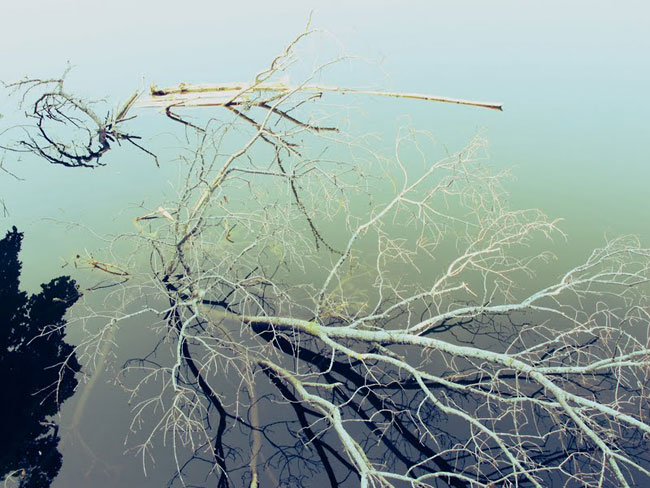
The leaves are pushing past and through the open hole. It has now been roughly two minutes since the bay window in the master bedroom blew in. A blast far more potent than the one dancing the leaves to and fro smacked the glass and ruptured the pane into so many pieces. I always loved the soft blue and ivory of the bay window frame for my own reasons. Now Daniel, he’d had his hiss over the color scheme when we played with paint chips – he in his underwear, I in a lace nightie – not so many years ago. So you want to live in Marie Antoinette’s abode? – he exclaimed as we rolled about on the new duvet. The fresh linen was crisp and smelt like dried lavender. I’d tucked little sprigs into the pillow covers when he was downstairs sanding the new mantelpiece. I thought it might mean good luck. Foolish thing, trying to alter the fate of a family.
All the golds and reds are pocked black with disease and born to the wind, seeking refuge on the rain spattered floor of our home. Daniel once said it takes a tree like that a hundred years to pass, but I think it’s dead now. I think it died in the moment between the bullet piercing Daniel’s head and the window shattering. I haven’t seen his body yet, but I can feel his blood seeping into the ground at the base of the trunk. The duvet is dotted with glass shards. They shimmer with wetness bouncing soft light, but still look sickly. The yelling from below stays a distant echo, my ears instead filled with sounds of wet leaves as they fold into the floor boards: the braiding together of two deaths.
They would be up for me soon. Daniel’s investigations would have us both executed. They had been leaking poison into the land, monitoring whether toxicity levels in trees directly impacted oxygen output. The devilish side project was to better understand human resilience. They’ll torch the house and the papers will first write about an electrical fire – the Scientist and the Wife had no time to escape. I imagined Daniel’s blood purifying the soil, the tree coming back to life in a dramatic flourish of fresh green buds and smooth brown bark. It would return to its virginal state from before they arrived – before Daniel was called in. A faint smile swept my lips. They were too late. The package had already been sent that same morning. Like blood, like toxins, the information too would soon be leaked.
My eyes fell closed. Let them eat cake! – Daniel had dotted my nose blue while we drank wine and painted the trim of the window. I had read someplace that blue meant protection. In my reflection from the dresser mirror, I can see now the frivolity of my clinging to that dot that had long since been washed away. Footsteps in the hall outside the bedroom door split through my thoughts like a knife. Moving into the window frame, I can see Daniel as my fingers trace the painted sides. A shard catches my skin. Blood falls, mixing with the rain water on the wooden floor boards below. The bedroom door bursts open and air gushes in, pushing and pulling from all directions. The wind catches my clothes as leaves peel from the floor and return to air. The noise, the lavender. I too am ethereal.
Interview with Eric Uwe Laufenberg, by Franziska Knupper
A conversation with the artistic director of Cologne’s Opera House about the life of an actor, his newest Richard Strauss production and about carrying an epée – en garde!
“This is where all the circles of my life are coming to a close, where they are finally meeting each other.” Eric Uwe Laufenberg glances at his audience, satisfied, relieved. People are sipping their white wine, some of them stretching their backs, others are chatting enthusiastically. Everyone is standing in a circle around Mr. Laufenberg and his microphone. It is a Saturday evening in the foyer of Cologne’s Opera house just after the première of Laufenberg’s newest opera production, “Ariadne auf Naxos” by Richard Strauss. Only one week before, Her Royal Majesty met with the director for coffee and conversation.
HRM: Mr. Laufenberg, what was your first step into the world of theatre? Laufenberg: I completed my degree at the theatre school Folkwang in Essen but soon felt the urge to leave, soon. After being in Darmstadt for a while and getting tired of it as well, I moved to the theatre of Frankfurt where I stayed for 5 years. That was probably the most exciting period at a German theatre I ever had in my whole life.
HRM: Frankfurt and theatre? Really? Laufenberg: Yes, at that time there were four different companies who all had a different approach towards theatre. Thus, it was an incredibly varied scene and I got the chance to have my first own production. With excellent reviews by the way. (laughs)
For Mr. Laufenberg, this was the smooth transition from being an actor to being a director. Since then he has been in high demand at all important theatres in Europe: Berlin, Vienna, Barcelona, Zürich or Brussels.
HRM: So why do you prefer directing to acting? Laufenberg: I think my interest already started in school when I was 14 years old and had my first production at the school theatre, “Pygmalion” by Bernard Shaw. I realized that every time when I was reading a text I said to myself: “What would that look like on stage?”
HRM: And now – again – you changed your profession from being the artistic director of a theatre to the one of an opera. Was this an important decision? Laufenberg: Fundamental. You really have to decide between theatre and opera. Before taking over this position I dedicated 80 % of my time to theatre. Now the opera has completely taken over.
HRM: Would a return to the theatre be possible? Laufenberg: Every year that I pass at the opera will make it harder to return.
HRM: But is there nothing like “artistic mobility” in your profession? Laufenberg: Not really. You will always be looked at as what you are at a particular point in time. So when I worked for the theatre everyone thought: “What the hell does he have to do with the opera?” And right now it is the other way around. So the chance to do a movie or a stage direction naturally diminishes with the time I spend here.
Here is Laufenberg’s hometown: Cologne. Here he passed his childhood, entered an opera hall for the first time and started working as a background extra, carrying an epée during a performance of Aida.
Laufenberg: In this region there was such a hunger for a metropolitan opera house! That’s why I wanted to bring Cologne’s opera scene back to its golden age.
HRM: Is that why you made all those sacrifices? Or was it because of your fascination for opera in general? Laufenberg: Both, I guess. I grew up with the melodies of opera. I lived and still live with all the different pieces and every production marks a different period in my life. And then this offer from my hometown – I just couldn’t resist.
That is why on Saturday, Laufenberg humbly stands in front of his microphone, describing how his life went in circles and how the beginning and end now meet in a city of western Germany. “Ariadne auf Naxos” has brought it all together again. It is a challenging piece, balancing amusement and seriousness, melancholia and shallowness. Laufenberg managed to create a universe of various emotions.
There is tenderness when the curtains in the back of the stage move for almost three minutes, seemingly wavering by the pure sound of music. There is beauty when the composer, the creator of Ariadne, sings of loyalty towards one true, everlasting love.
HRM: So what makes you choose a particular piece to put on stage? Laufenberg: Curiosity? There are still so many operas left which I haven’t done so far. For example Verdi, that would be new territory for me. (Contemplates for a moment). So maybe Verdi next time? But really in the next two months I have to make two more general decisions: Will I stay in Cologne? And will I stay at the opera?
Those questions seem to be hanging there in the tranquility of his office and later in the burst of applause after his speech. Then it was the audience’s turn to do some work after two hours of remaining silent in their seats.
And to explain why he chose to follow the path of music, Mr. Laufenberg offers: “Because music is the holy art.”
Raoul Colvile is a writer living in East London. At weekends he takes his voice for walks. Click below to hear him read his short story, “They went to the sea”.
He woke before her and, for a while lay, still. The sun was growing in the little room. It was warm and there was gold and dust trapped in the air. It was a Sunday and there was nothing to do. She was still asleep, the sheets white against her skin. He watched her breathing, the tiny repeating rise and fall in her shoulders and back. She was small and dark, her bones as fragile as fingers. He was still not used to her.
After some time he moved to get up, disentangling himself from the sheets, careful not to wake her. He could smell jasmine from the window boxes outside. The flat lay quiet in its corners, dark and cool, as if holding its reserves for another hot day to come.
He went into the cramped kitchen and began, quietly, to make tea. The debris of his cooking was still there from the night before: red chilli, chopped fine on a cream board; the half bulb of a skinned onion, greying now; two glasses of wine, like the puddles in the park from the week’s thunderstorms, half evaporated by the sun. She had carried them through from the table after dinner -“What kind of a girl did he think she was?” – she’d help him with the washing up.
But it all lay in the sink now, the plates like listing ships, half deep in water. She had kissed him and laughed, then they had gone to bed instead. He could see her lips, a pollen stain, on the outline of the glass and in the street outside there was only the summer morning.
The tea was in white china, and there were the faintest smudges of previous cups on its surface. He had no dishwasher and sometimes the water didn’t run hot for long enough. He went back into the room and she was still asleep; he could see the outline of her legs, her side through the material, and her fists holding the thin sheet, balled up beneath her chin. There were ripples in its surface and the shadows played in them. He placed the cup softly on the planks of the floor next to her and sat on his desk facing the bed. He watched her sleep for a while more, trying to take it all in.
How small she was in the bed. He could see his imprint, bigger, where he had been – a Russian doll echo. Close to her, but gone. Her skin again, always her skin, smooth and dark but with that gleam in its depths when he looked hard. And the delicacy of her face, the points of her nose and chin, which held, directed, and from which everything flowed.
He watched her a while more and when he moved he did not think too much about it, he just opened the drawer and found the book. It was where he had known it had been, slightly dusty, the bump of a pencil wrapped between its folds. He had not drawn since the last one. Now he began to leaf knowing that now he would have to see her again, and it was worse this way than with the photos he had thrown away, those short months before. He opened the pages and there she was, the last one, through his hand, his eyes.
There was her sitting amongst the trees on the hills where her family lived; her standing in the Cathedral cloisters of the town where they had met; her naked and reading in a room they had once shared; her and him together.
He turned past this other woman until the blankness of a fresh page was smooth before him. He waited a second; there were no cars in the streets outside and the town was still. Then he began to draw the bed.
His hands were out of practice but his lines, just like his own bones, were still there. He worked a little while and eventually she woke, stirring beneath the covers, the ripples flattening over her stomach and the hollow between her legs, rising over her small breasts as she moved onto her back. She opened her eyes and looked at him, half-shy to be caught like that.
He told her there was tea there for her on the floor and she smiled. He put the book and pencil down on the desk and leant forward as if to start saying something. “What were you doing?” she asked, looking at him, and he was checked. “Nothing.” Then again, “there’s tea there”.
She narrowed her eyes. “Were you drawing?” she asked, and it was his turn to be shy. The dust speckles were golden in the air. She moved a little and he heard the hiss of the sheet. “You are a strange one aren’t you?” There was affection in her voice and quite suddenly he looked away because just then, he wanted to tell her about it all; the hundreds of past hours spent and maybe wasted, the importance of it and the size of the want to be good; just then, he wanted her to understand it. The way he had thought the last one had. But he couldn’t.
It was only time, not words, that could do that.
So instead, rocking back on the desk, he replied “Who, me?” and pretended to look around the room for someone else who could be drawing. He smiled. It was a morning for soft voices. “What sort of a person would do that?”
Then she smiled too. She took her tea and sipped at it, sitting up in the bed so that the cover fell away and her breasts and the skin of her stomach were bare. He looked at her, moving his face only slightly and she smiled again. “Definitely a little strange,” she said, and he stood and crossed to her and put his knees on the bed.
The sketch book lay open on the desk. The grey of the pencil, like the thought of a cloud, in half-finished panels across her legs. The small of her back gave the impression of a figure, veiled. The book lay still, the light breaking across the paper – the suggestion of her face.
***
“You promised me we would last night,” she said, her head on his chest. He was looking at the ceiling and tasting the warmth in the air that was stealing in through a narrow gap beneath the crooked window frame. “We have to go.” He looked at her, saying nothing; it was going to be a perfect day in the town. “Come on,” she said smiling, “you made a promise. And I want to see the sea. You aren’t that sort of a boy are you? One to break promises?”
“No,” he said, “I’m not”. It was a simple answer to give and he could say it without feeling it was in some way not true. It felt good, to be able to say something definite about himself and to expect her to believe it.
So they showered together and washed the night off them, then wet-haired left the flat. The sun was higher still and the air was hot. There were sparks of sweat on the hands they held with, and with that still, the prickle of newness.
When they reached the station he said “I’ll get this,” bowing low. “Whatever next,” she said and skipped towards the platform, grinning. He bought the tickets and they got onto the train.
At the seafront they stood and leaned over the railings, flaking and green metal. They looked at the sea, stretched out like a floor, forever in front of them, and felt the heat on their skin. At their backs the stone buildings had the faces of old sailors. There were not many people around. “Shall we walk further up,” he asked, and she nodded. So they did.
On the hills behind the beach was wind beaten grass. They were alone.
The sand moved thick and hot between their feet and so they went to the very side of the sea where it was cool and the breaking water made it hard; it was flatter and they walked easier, talked.
There was a breeze coming in off the water and she asked him about his family and he, about hers. She said she was an only child, and he told her about school and university, and the job he did now; all the things that made him a real person and meant nothing, and she did the same. She told him about her home.
The sun was sinking lower and they turned around and began to head back, through in a wind-worried carpark where the tarmac was salt edged they bought an ice cream and shared it. She asked for tea too, from the sad little kiosk, with sugar. She took it down in slugs. He had not known that she liked it that way and thought of all the cups he had made her recently, which must have all been sour for her.
From the carpark they could stray out onto a cliff that was the shape of a wave and overlooked the sea. He scrambled up its crumbling lip to stand right on its edge.
She came to him then and put her hands in his jeans’ pockets, so that the backs of her fingers were against his legs and she kissed him like that, and like she had kissed someone else that way before. He thought of her last one, feeling the practice in her kiss, whoever he might have been, and was jealous. Jealous of it being there with them, and resentful of its imposition.
Then, he thought of the sketch book.
But he kissed her anyway because there was nothing else to do, and it was always this way, and it was all hopeless.
Sand-footed they began to walk slowly back, looking again out to the sea, which the sun was dipping into now. He asked her what had happened with her last and she told him, and she asked him, and he told her the same. Then they were quiet for a while.
“What do you think it’s like then?” eventually she said.
They walked on a few paces and he noticed that there was a stone lying on the shoreline, the sand, like icing sugar, gripping one of its sides.
Moving away from her he went to it and picked it up, feeling the weight and coldness of it against his palm. He waited a moment, looked back to her.
Then he threw it out across the water. It skimmed a few times and then sank.
“That is what I think it is like,” he said, looking at the impression it had made fading from the surface of the sea; each skip, each perfect little centre with its ripples moving out, each instant, disconnected and yet still part of the others, as if in them was everything of beauty and everything of death.
She looked at him seriously, and she was beautiful still, and kissed him again.
The tide was coming in, and they started to walk once more, back along the shore, the marks of their feet, pitted in the sand, filling, drinking in the water, the low sun. They walked back towards the station and the town where they both lived.
The train was not due for a while, and there was nothing to do but wait.
The German Band WunschWG performed their song “Marie“ in the exhibition halls of the Kulturbunker, a music venue and gallery in Cologne.
Three members of the band brought their acoustic guitars and a few bottles of the local beer; they were relaxed and casual. Just like a couple of friends getting together and playing their music. And when they played they filled the room with clear guitar sounds and a single voice. A room full of pictures and sculptures and a flickering TV in the corner. But their eyes were somehow fixed on distance except for a couple of glances towards each other.
“We are used to sit together, experiment and jam together, that’s how it all started,“ explains Marc, the singer. Usually it’s him who writes the lyrics but the melody is something they all have to create together. “Once we have found a leading melody, everyone is responsible for the part of their own instrument,“ Lene, the only girl of the band, explains. “But if someone really does not like an idea we have to drop it. It has to be total democracy in a band,” she says. “Fortunately it didn’t happen so, we seem to have the same taste,“ she adds, smilingly.